Distinguished Paper Award @ ACM CCS 2026 for Research on Apple iMessage Privacy
The paper, “Blue Bubbles, Red Flags: Investigating Privacy Leakage in Apple iMessage”, has received the Distinguished Paper Award at the 2026 ACM Conference on Computer and Communications Security (ACM CCS) and is a collaboration between Viktor E. Garske (University of Applied Sciences Stralsund), Swantje Lange (Hasso Plattner Institute), Gabriel K. Gegenhuber (IT:U), David Schmidt (University of Vienna, CDL AsTra), Andreas Noack (University of Applied Sciences Stralsund), and Jiska Classen (Hasso Plattner Institute).
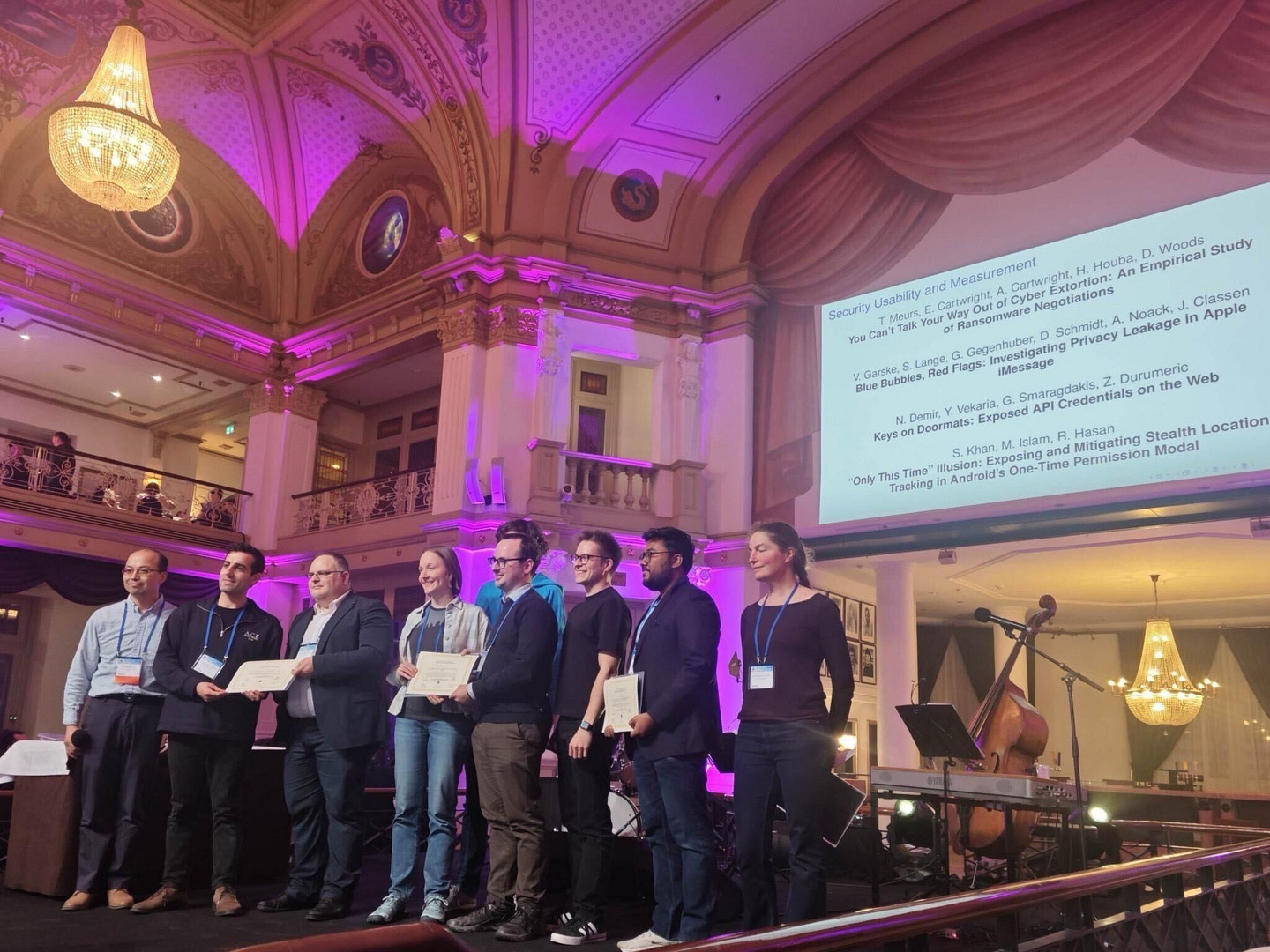
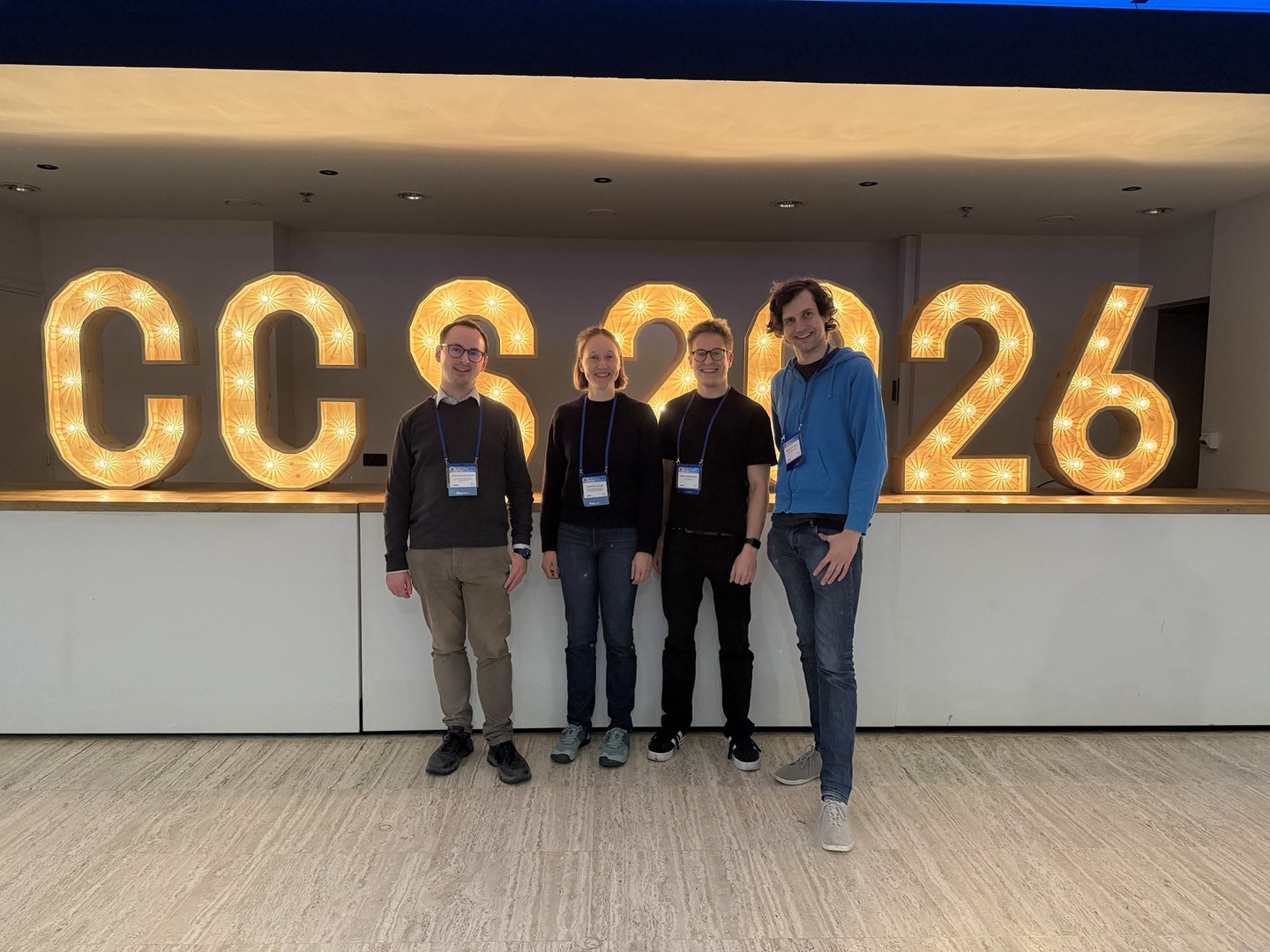
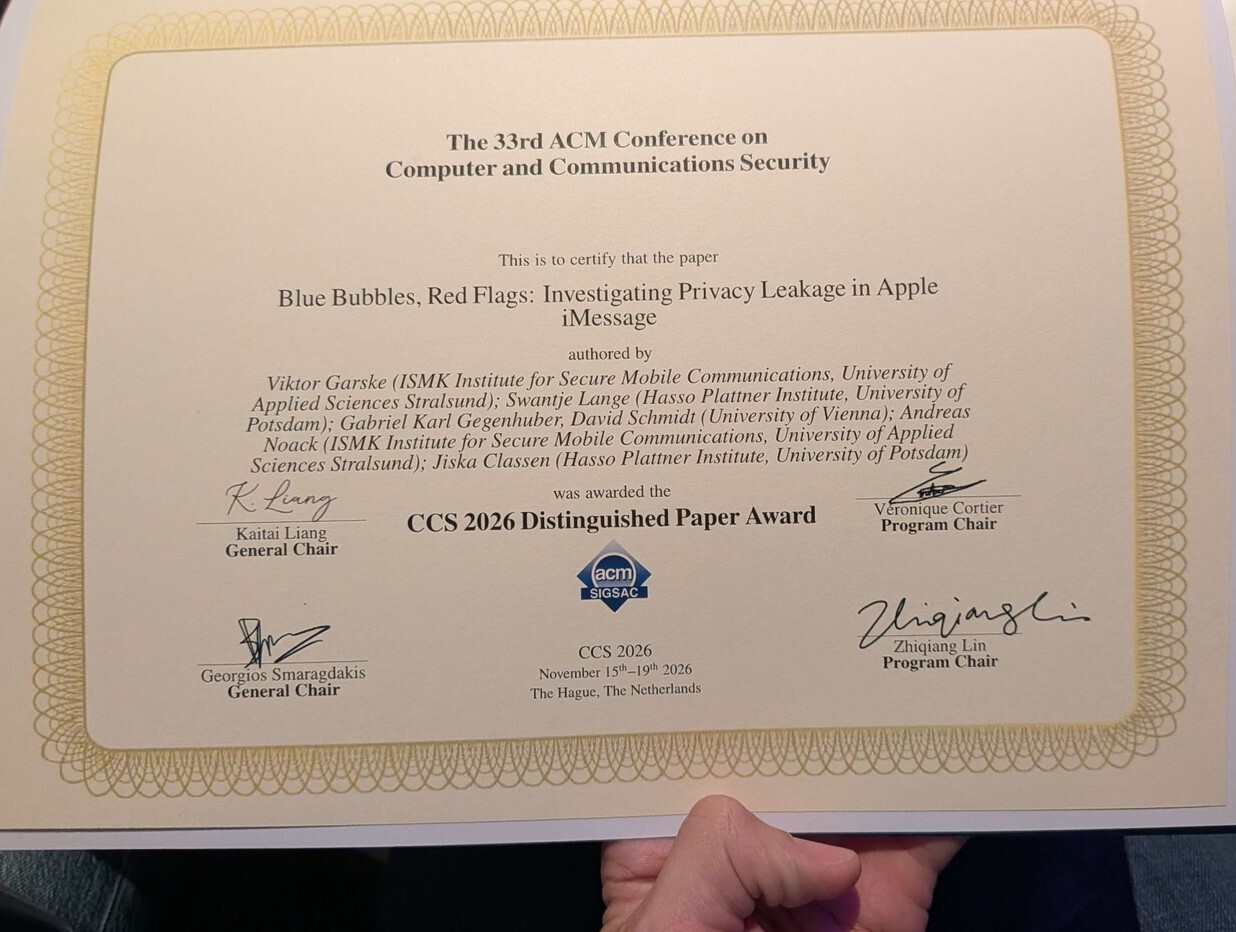
© ISMK/HPI, Marie Fischer, David Schmidt
The paper presents the first systematic analysis of privacy protections and information leakage in the iMessage protocol implementation. Although Apple promotes iMessage as a secure messenger with end-to-end and post-quantum encryption, the researchers identified several potential privacy risks beyond message content encryption.
Their findings show that attackers can silently:
- Identify users’ device types and operating system versions.
- Infer when iMessage clients are online through delivery receipts.
- Derive approximate user locations by observing delivery receipts and attachment uploads.
The research highlights that strong message encryption alone does not guarantee comprehensive privacy protection. Protocol-level information leakage can still expose sensitive information and create opportunities for targeted attacks.
Abstract
Apple markets iMessage as a secure, private messenger that uses modern post-quantum encryption for message content. As iMessage ships by default with iOS, the predominant mobile operating system in the US, and serves around 1.4 billion active users, it exposes a substantial attack surface. Despite this reach and relevance, there is a lack of public research on non-cryptographic protocol properties.
In this work, we present the first systematic analysis of the iMessage protocol implementation, focusing on privacy protections and information leakage. We show that attackers can fingerprint the device type and operating system version of each iMessage client, a piece of information that facilitates reconnaissance and targeted attacks. We demonstrate that attacks targeting individual clients of the same user are feasible. We further point out that delivery receipts enable attackers to infer a client’s online status and coarse location.
The latter can also be derived by observing attachment uploads. All of the attacks are silent.
Authors: Viktor E. Garske, Swantje Lange, Gabriel K. Gegenhuber, David Schmidt, Andreas Noack, Jiska Classen
Congratulations to all authors on this outstanding achievement and international recognition!