Congratulations to Kevin Mallinger on Successfully Passing His Rigorosum
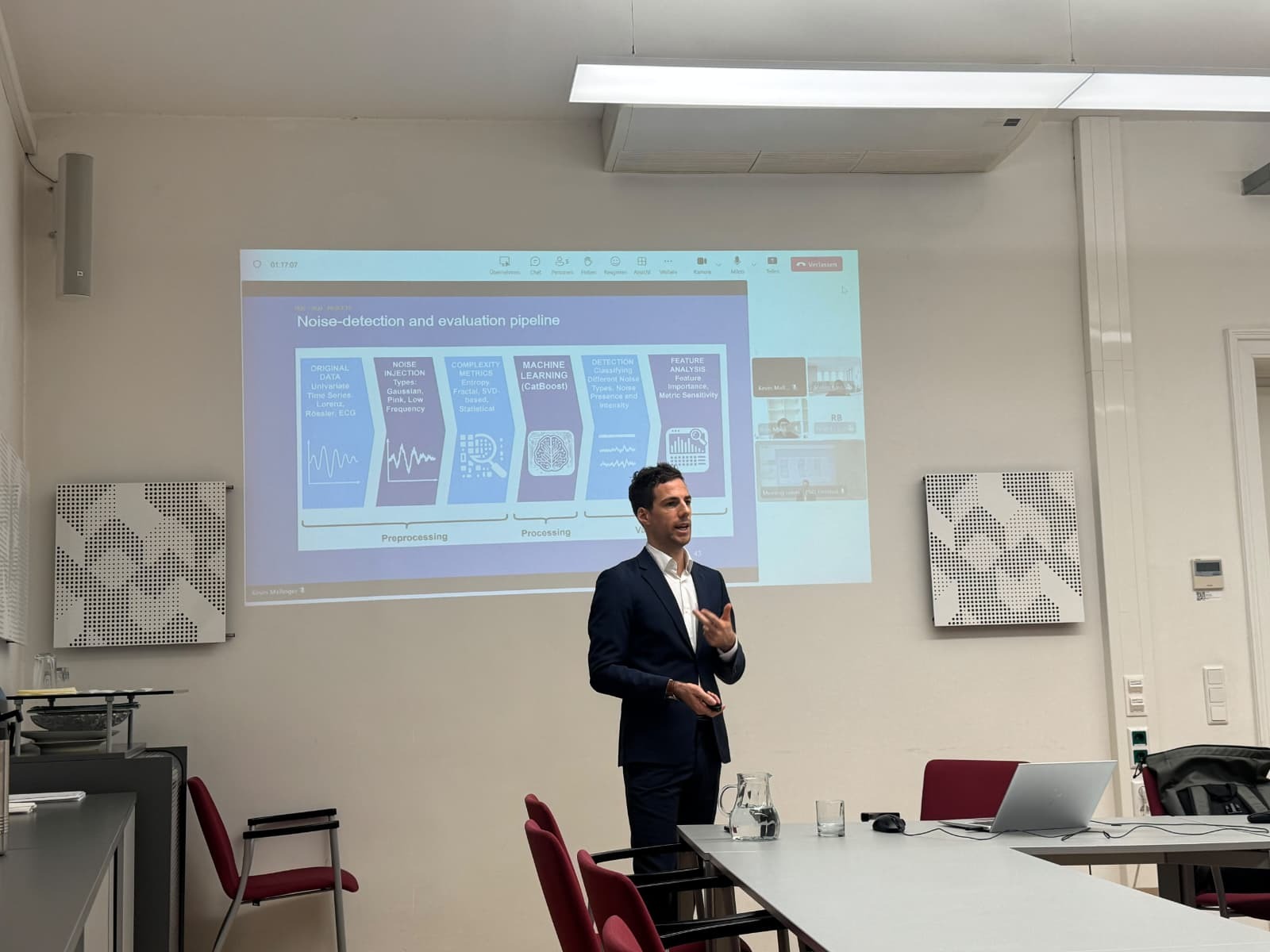
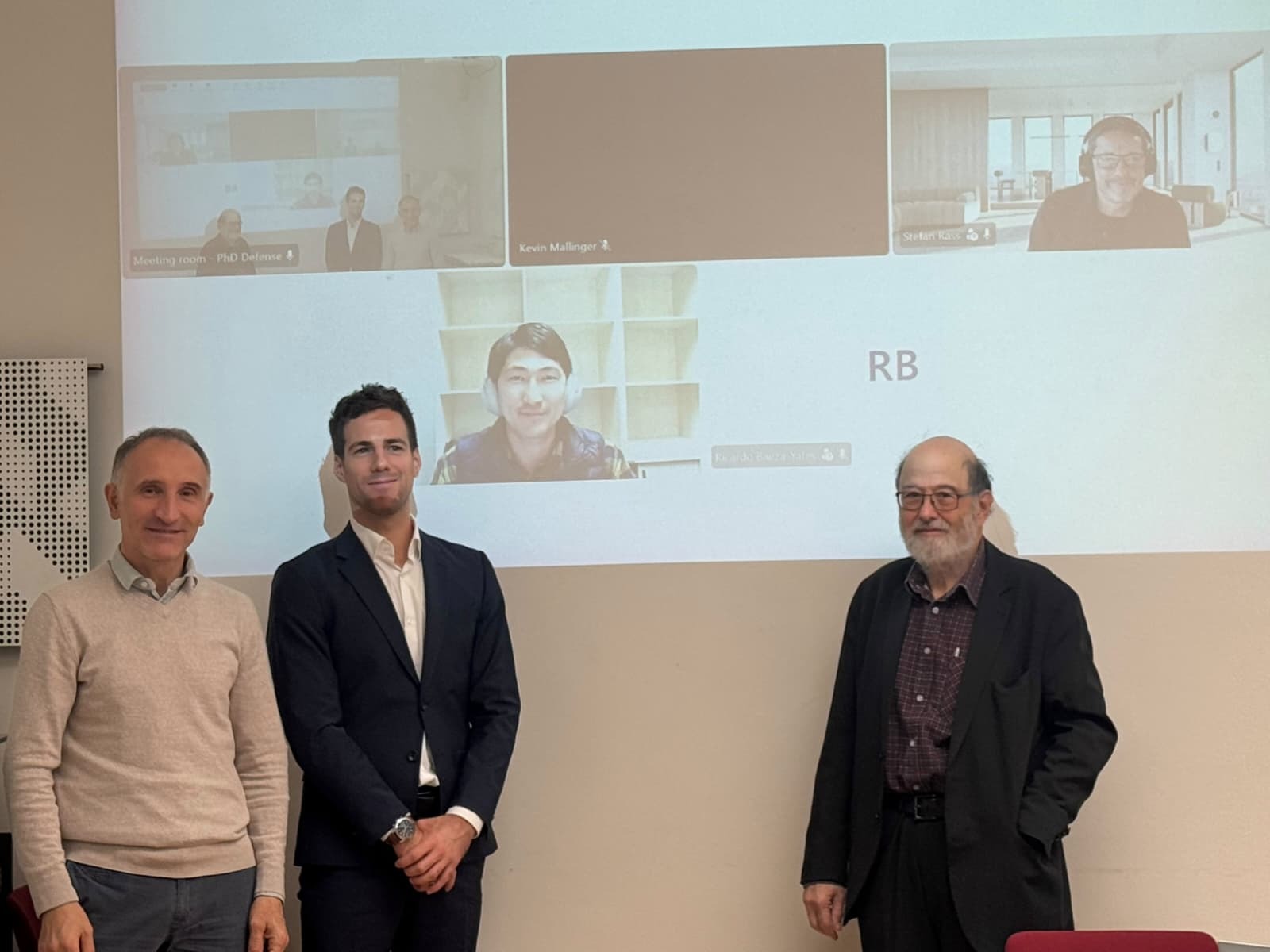
Last week, Kevin Mallinger, Head of Complexity and Resilience Research Group and of Applied Research Area at SBA Research, successfully defended his dissertation, “Sustainable Development of Supervised Machine Learning in Socio-Technological-Ecological Systems,” and received excellent evaluations.
A Min Tjoa and Ricardo Baeza-Yates supervised the dissertation, while Stefan Rass, Masahiro Ryo and Nysret Musliu were members of the defense commitee.
© SBA
Abstract
Machine learning systems are rarely used in isolation. When deployed as mediators between nature and humans (e.g., farming, water management), they are embedded in socio-technological-ecological environments characterized by nonlinear interactions, feed back loops, cross-scale dependencies, and evolving stakeholder interests. The sustainable deployment and development of machine learning algorithms, therefore, depends on the effective translation of complex requirements across key stages of the AI development lifecycle while retaining the ability of the algorithms to generalize well.
As current methods are often limited in their ability to support developers in this task, this dissertation builds upon research from complexity, information theory, and nonlinear systems sciences to provide several contributions to foster the sustainable development of supervised machine learning approaches. This includes mental and mathematical frameworks that guide scoping and requirement engineering, methods to assess multidimensional nonlinear requirements and guide architectural design decisions, quantitative approaches for uncertainty estimation, feature extraction, dimension reduction, and noise detection.
Across 8 publications, it combines qualitative and quantitative approaches to capture discrete dynamics but also qualitative dimensions that cannot be measured so easily, such as trust, cultural context, or institutional embedding. In doing so, the dissertation aims to contribute to a more holistic paradigm of machine learning design that aligns technical innovation with social and ecological sustainability.